Andalusian Courtyards and Tiles: How to Read a Courtyard in Andalusia
To appreciate an Andalusian courtyard, start with its plants and its walls: they hold its history. In Córdoba a courtyard contest is held every spring, and other cities in the region hold similar festivals. The courtyard is the heart of the Andalusian house and a place to gather. How do you interpret what you see when you stand under a gallery or in front of a tiled wall? This guide shows what to look for so you can better understand the Andalusian courtyard, its plants and its tiles.
Where the Andalusian Courtyard Comes From
The Andalusian courtyard blends Roman and Muslim building traditions. Roman houses were built around a central atrium. Its colonnaded galleries, wells and fountains are forerunners of the courtyard that developed later. That layout endured and Muslim culture adapted it. In this type of courtyard, the gallery, the well and the fountain organize the space of the whole house, so they are worth noticing first.
Islamic influence brought in the idea of the paradise garden, with eastern roots going back to Persia and Arabia. In al-Andalus the courtyard developed from the tenth century onward. That is why the Andalusian courtyard is far more than a simple passageway: it is an enclosed, orderly garden where the life of the household unfolds. That everyday use explains its role as a meeting place.
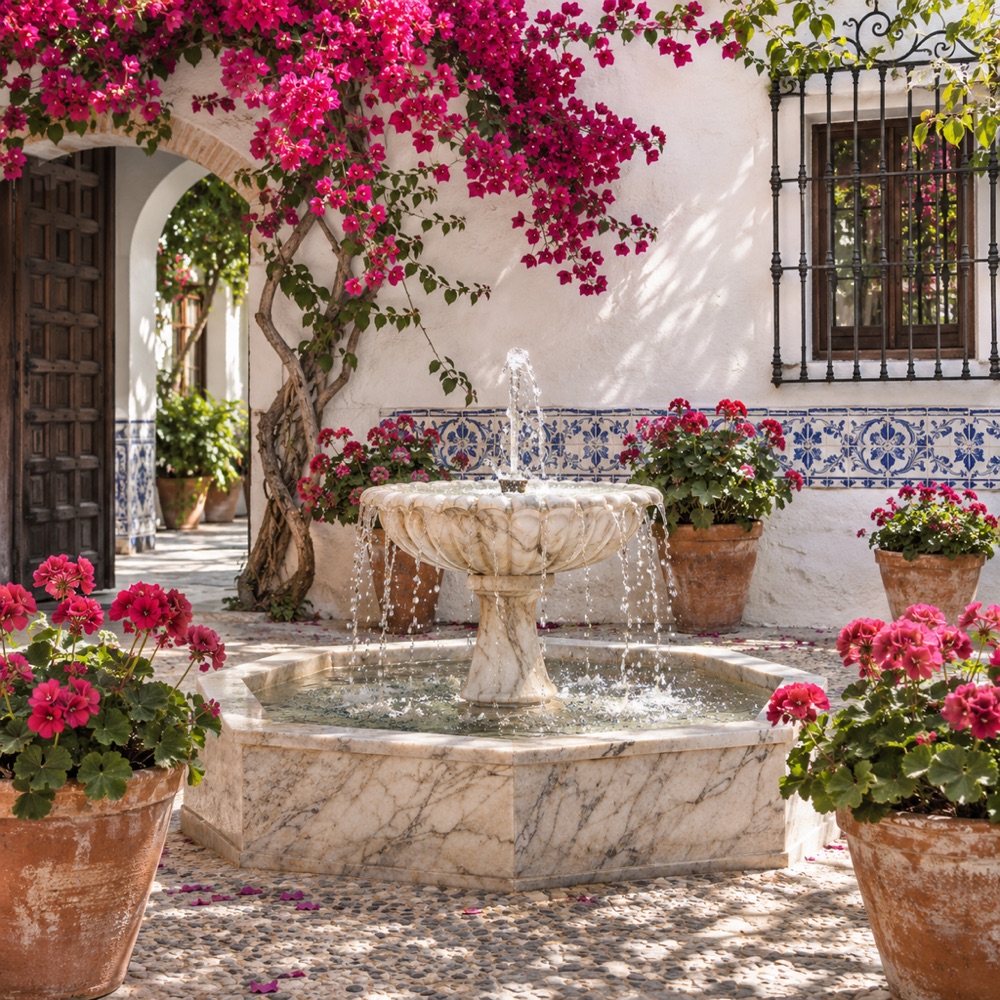
Plants and Bougainvillea: What the Courtyard Walls Tell You
The plants that surround the courtyard and cover its walls are its most characteristic feature. At first they were used as religious offerings or as a tribute to the dead. Over time, greenery also served to hide flaws in the walls, so besides decorating it had a practical purpose. Walls covered in plants thus reflect both their religious origin and their everyday usefulness.
Today you can see many species on the walls, bougainvillea among them. When you visit an Andalusian courtyard, look at the plants as part of the construction, not as a mere addition. Courtyard contests are better known in Córdoba than in Seville, and the spring traditions also include the Cruces de Mayo. On those dates the courtyard becomes a place of celebration for the whole neighborhood.
Tiles: How to Read the Wall Coverings
The word azulejo comes from the Arabic az-zulayj, meaning glazed clay. An azulejo is a thin ceramic plate with one glazed face. Tiles reached Europe through al-Andalus and, from the thirteenth century, spread across the continent. The ones you see on a courtyard wall are therefore a trace of how Andalusian culture traveled.
When you look at tiles, pay attention to the technique used to make them. The techniques include cuerda seca, cuenca or arista, and majolica. Each produces a different effect, and in a single courtyard you can find tiles made with several of them. Also notice whether the motifs are geometric or figurative: that distinction will help you describe what you see.
Where to See Courtyards and Tiles in Person
A good starting point is the Royal Alcázar, whose courtyard brings together several traditions. There you can see how the Roman layout and the Muslim garden are fused into one complex. The second stop is Casa de Pilatos, known for the Pulido tiles from 1536 to 1539. The tiles are the stars of the visit, so give them more time.
The third stop is Palacio de las Dueñas, where you will see the main Andalusian-style courtyard and the Patio del Aceite. These two courtyards let you compare the layout, the plants and the walls within a single building. You can then confirm that the courtyard does not follow a single model but a tradition with many variations.
At any of these places you can follow the same order of observation. Look first at the layout of the courtyard, with its gallery, well and fountain; then at the plants; and finally at the tiles on the walls. The courtyard then stops being a pretty photo backdrop and becomes a record of Roman, Muslim and later influences. Keep exploring the architecture and ceramics of Andalusia in our upcoming guides.